Sunday, November 26, 2006

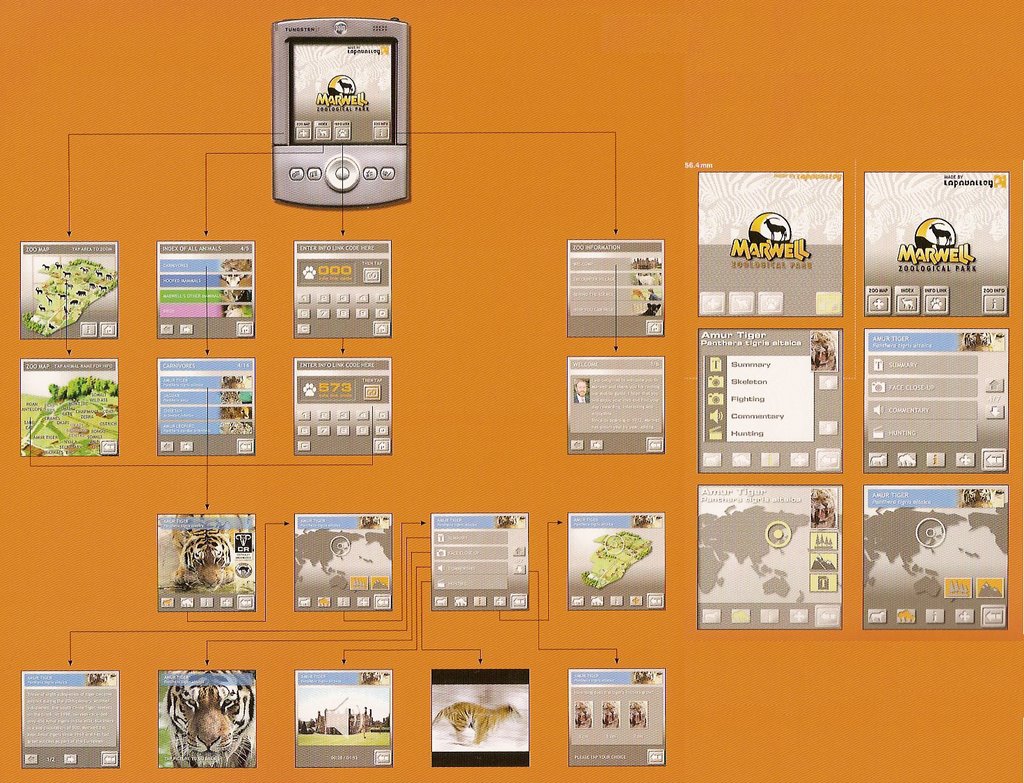
The Creation of a Multimedia Guide to Marwell Zoo, Winchester, UK


Christian Langer, Lapavalley GmbH


“Multimedia guides for museums, exhibitions and similar venues were already a subject of discussion in 2002. So when we founded our company, we realised that we needed to set ourselves apart from potential competitors and find our own market niche. We developed the idea of producing mobile multimedia guides for zoos, animal perks and aquariums. To be as convincing in our acquisition of clients, we designed a realistic demonstration guide.

To make a name for ourselves, we sent a brochure describing the exact functions of our guide to almost all the zoos In the UK. We were fortunate to receive a positive response fairly quickly; Marwell Zoological Park in Winchester was interested.

In an Initial meeting we presented our demonstration guide to the zoo's Director, Deputy Director, Marketing and Promotion Officer and Head of Education, The reactions were very positive, but we were not able to remove all doubts about this new technology. Marwell was very interested, but the zoo was not keen to be the first zoo in the UK to bear thee full risk of funding such a project. However, we wanted to preserve our chance to implement the pilot project as far as possible.

After brief negotiations, the two parties came to the following agreement: Marwell was willing to fund the hardware, and we were willing to develop the software, free of charge, as our share of the risk, The potential revenue from hiring the device to visitors was then to be shared.

Marwell was very cooperative in the organisation of the content and the interface design. Of course the guide needed to fit in with the existing corporate design, but otherwise we largely had a free hand and were able to experiment with the system in the location until we, along with the voluntary testers and the responsible parties, were finally satisfied.

The picture material that Marwell sent to us in the form of a VHS video and some photo CDs proved to be almost redundant. There was obviously some confusion about the entertaining and instructive potential of our multimedia guides - alter all, a visitor does not want to see a video clip of a sleeping panther if he is standing in front of the enclosure in which the same panther is sleeping.

So we decided to produce the picture content ourselves. We went inside a number of animal enclosures, hid the feed of big cats inside jute sacks, stroked rhinos, tapirs, bird-eating spiders and more, and we recorded everything on video or by taking photographs, We also interviewed some keepers, and we accompanied the vet on his rounds. After a week we had collected enough material to fill the guide with exciting and informative content.

Initially we had problems with the hardware. The PDAs had to be enclosed in a waterproof covering so that they could survive both wet weather and accidental submersion in the penguin pool! However, the plastic waterproof bags with transparent windows, which were specially made for the device, had a detrimental effect on the contrast of the displays, and this effect was exacerbated in bright sunlight, After two weeks of conducting usability tests carried out with volunteers from all age groups, it was clear that the contrast of all graphics had to be enhanced in order to ensure their legibility.

In August 2003 we launched our first multimedia guide, almost 10 months after our first contract with Marwell. Now the devices have been in operation for more than two years, and all parties are more than satisfied with the results. The number of units hired out per quarter shows very clearly that our work was worthwhile and visitors to Marwell have enthusiastically received the guide.”

I think that this article helps to give a true insight into implementing a digital device for a particular purpose. It shows that when creating the device you need to work closely with the client to make sure that you are both working towards the same thing. Marwell zoo stated what their needs were and then the creators were then allowed to do what they wanted with these requirements as they had the knowledge as to how was going to be best to implement it.

The article also showed me that there can be many unforeseen problems that can hinder the project. The article states that the designers used usability testing and this helped to show the real problems with the device before it was launched. The results of the project show that the constant development and revisions can mean for a hugely successful result.

I will be considering these areas when designing my device, as I will need to conduct lots of research into how my device is going to be technologically feasible. I will need to realise the problems that it may encounter and work our ways in which i can prevent or overcome them.

Monday, November 20, 2006

Text on Screen

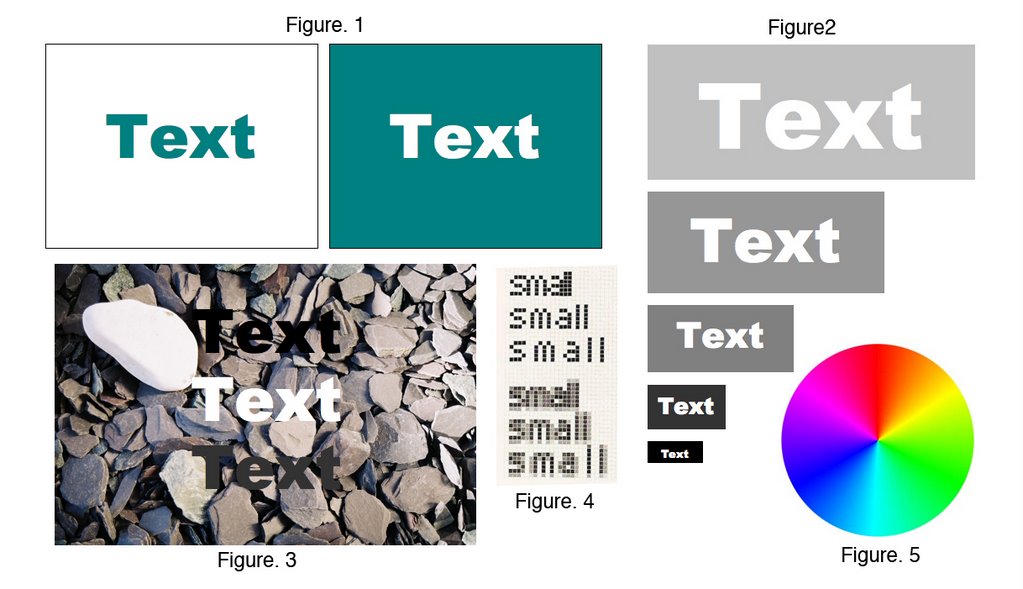
Text is a visual interface for language. In contrast to speech, which is linear and will usually need to be heard in full before the listener can understand the meaning, written text offers a variety of possibilities for access and use. Written text can be read thoroughly, skim through or it can be ‘scanned’ for key words or phrases. Although small-screen devices are already multimedia machines, the incorporation of text on the display will play a decisive roll as an information medium. This is probably because the transmission of information by the written word, particularly in a public setting, can be done far more discreetly than by the spoken word. (fig.1) In order for text to be clearly shown it needs to be presented on a contrasting colour to the text itself. (fig.2) The smaller the text is the darker the background needs to be in order for it to be seen clearly. (fig.3) An intricate background always makes legibility difficult. Therefore it should especially be avoided on small screen devices. (fig.4) Increasing letter spacing improves the legibility of the text on screen. (fig.5) When showing text on a background it is often best to show it in the most contrasting colour to the background, this will often be the directly opposite colour on the colour wheel.

Sunday, November 19, 2006

The iPod and the Culture of Mobile Listening


I wanted to investigate how iPod users re-inscribe their experiences of commuting through the use of music. I recently saw a television documentary that discussed briefly how the Japanese were the first consumers to use the iPod to give them an unprecedented power of control over their experience of time and space. The users were living in an environment that is busy and overcrowded through the levels of commuters travelling to work every day. The users would manage their moods and orientation within this crowded environment through the ‘micro-management of personalised music’.

I am going to be using an article written by Michael Bull from the Department of Media Studies, University of Sussex, UK called ‘No Dead Air! The iPod and the Culture of Mobile Listening’ to help me argue my points.

Within our cities people commute everyday often by means of public transport to and from their places of work. These people have a need for ‘social proximity and contact in daily life’ (Katz & Aakhus, 2002) With the introduction of the MP3 player the user has complete access to their entire music collection whilst on the move, therefore allowing them to be ‘warmly wrapped up in their own personal space’ (Bull, 2005, p343) and morphing their surrounding space into a visual mindset that can reflect their own mood. Older devices meant that consumers were limited to only a few tracks to choose from therefore meaning that they would have to listen to the same track often, this would then mean the user would be forcing the environment that they were attempting to inhabit to mimic their own mindset. With the creation of the iPod the user is able to choose from thousands of tracks ultimately allowing them to manage their thoughts feelings and observations through any track they like.

Michael Bull states that consumers use the iPod to ‘fill in the gaps’ in-between communication or meetings. I would agree with this statement to the point in which I consider how Apple have also introduced a complete range of products to compliment the iPod. The iPod has become a part of the home, the car and many other environments because of these products that allow your iPod to communicate with your Hi-Fi, car, computer etc and so therefore giving the user the ‘unprecedented ability to weave the disparate threads of the day into one uniform soundtrack’ (Bull, 2005).

It is possible to alike this idea to Raymond Williams’ arguments that people are privatising themselves and the media that they consume to ‘the living room - and increasingly the bedroom’. People are shutting out what is not important in their lives and the ‘desire for company or ‘occupancy’ whilst moving through the city is thus contextualised through the daily or habitual use of a variety of media’ (Bull, 2005, p.345). The freedom of mobile sound media enables the user to maintain a sense of ‘intimacy’ whilst moving through the city. Adorno in his book ‘Introduction to the Sociology of Music’ states that ‘music creates a form of sociability in a world that is increasingly bereft of it. As such, music performs as an ideological function of integrating the user into the world’. I personally believe that this refers to the fact that people hate unusable time. Consumers need something to capture their imagination in order for it to be important in their lives. Day-to-day commuting does not accommodate this capturing of imagination so therefore people will seek to cover up these irrelevant areas by converting them into the soundtrack of the street. Consumers can use their portable music change the environment and create their own individual movie, unrealised by public around them. For example a user can walk down the same street and it will look busy and colourful one moment and then – when a different song starts – it can change to a mysterious and unnerving place.

The creation of a personalised soundworld through iPod use creates a form of accompanied solitude for its users in which they feel empowered, in control and self-sufficient as they travel through the spaces of the city. iPod's tend to be non-interactive in the sense that users construct fantasies and maintain a feeling of security precisely by not interacting with others or the environment.

Friday, November 17, 2006

Mobile Keyboards


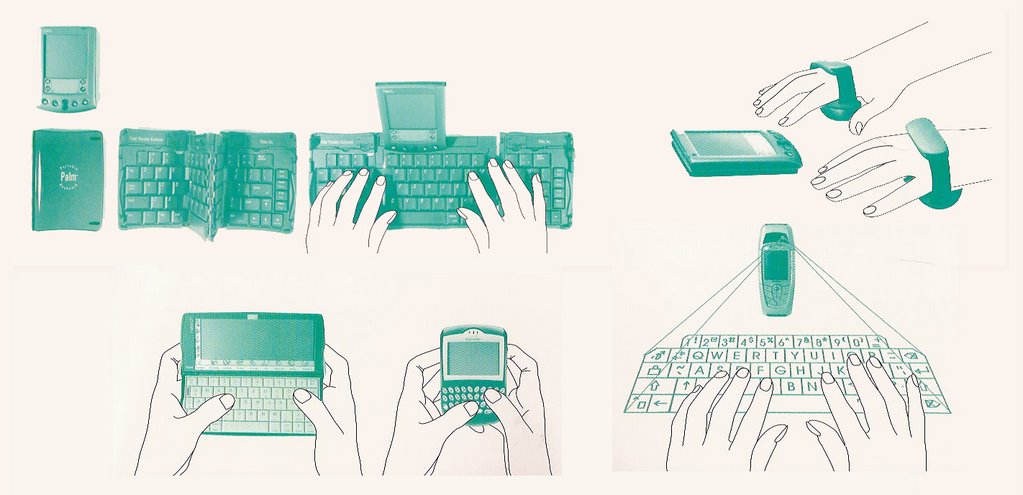
Trying to incorporate a 'QWERTY' keyboard into a small screen device is the second problematic factor alongside the small screen limitations. Folding keyboards are available for PDA's and some smart phones however this still constrains the user to a static seated position and so therefore these devices have not been very successful, as the consumer will often decide that they may as well use a laptop.

There are several variations of virtual keyboard. One device in particular is available in the form of gloves that interpret the movement of the fingers. Again this invention has not been very successful, as often the device will misinterpret the words being written and therefore resulting in slow productivity levels.

Alternatively, a virtual keyboard can be projected onto an external surface. This device also requires a greater degree of user attention and as a result is unsuitable for peripheral use. All of the above devices are ultimately limited due to the space required for the keyboard, the need for the user to be in a static position and the small screens. Therefore in my opinion i believe that companies should stop trying to invent these 'virtual keyboard' devices and consider a blue sky approach incorporating technologies from other areas such as gaming etc as it appear these limitations are not going to be overcome by concentrating on the areas currently struggling to be developed.

Talk by David Garcia

During the first week of November i attended a talk by Professor David Garcia on Digital Cultures and their impacts on Knowledge, Networks and Freedom at the University of Portsmouth.

During this talk David discussed areas that very much interested me and i considered how they could be implemented in the Designing for Digital Devices.

He talked about how in Italy it is well known and understood that after a certain time in the evening, when all television broadcasting has finished, a group of people will often hijack the TV broadcasting to broadcast their own messages. They are not necessarily breaking the law but the area that interested me the most was that these people were using the 'downtime' of this platform to capture an audience. They were manipulating technology to their advantage and using it in such a way that had never really been considered.

I was able to apply these ideas when considering designing for digital devices as i started to think about using the technology that is already available to us and using it in such a way that hadn't been considered and in a way that it hadn't been designed for. For example i developed the idea of using the camera on our mobile phone to pay for things. The user would point the camera at a barcode say for example a vending machine and then send this picture off and the cost of the item from the machine would be deducted from the users credit. This could also be used by way of SMS (short messaging service), the consumer could fill out the code on the machine and then send this text message off to the vending machine company e.g. Coca Cola and they would receive a reply containing a code that they would enter into the machine in order to receive the product. This idea could be seen to take more time than the standard approach of just entering money however it would save time if the consumer did not have any change on them at the time.
I have seen this idea used before but in a different way. Frank Lantz, with help from Mattia Romeo and Dennis Crowley created a big urban game called Conquest. The game involved a group of people competing with each other to take over certain urban areas. This would be accomplished by taking pictures of semacodes, which are two-dimensional barcodes that can be scanned and decoded with a camera phone. These semacodes would be placed on particular objects within the environment and then the participants would have to take a picture of the code in order to conquer that area. Again this is a very clever way of using current technology but in such a way that it was not intended.

CLICK HERE to visit the Conquest homepage


"We make computers and computers make us'' this is an area in which David Garcia touched on but it did capture my thoughts. When i thought about this statement more it made me consider how this really is true. The world we live in today is in such a contrast to that of 5, 10, 20 years ago and why? well, because our lives are adjusted as these digital platforms become more of a part of our lives. We create these devices to make our day-to-day processes more efficient, and as a result our day-to-day behaviour changes. For example the media no longer controls us as we can consume this content wherever and whenever we like. Yes, i still believe the media can have an influence over the audience and often shape our social and cultural identities through social grouping, but we consume it on-the-go and as a result i feel people discuss their opinions a lot less therefore these devices are contributing to making us who we are as a person.

CLICK HERE
for David's Blog